If you’re shopping for beachfront or ocean-view property in Costa Rica, you’ll eventually hit two words that change everything: titled and concession. They can look nearly identical in a listing, with the same palm trees, the same ocean view, and sometimes even a similar price. Legally, though, they’re two very different things, and mixing them up is one of the most expensive mistakes a first-time buyer can make.
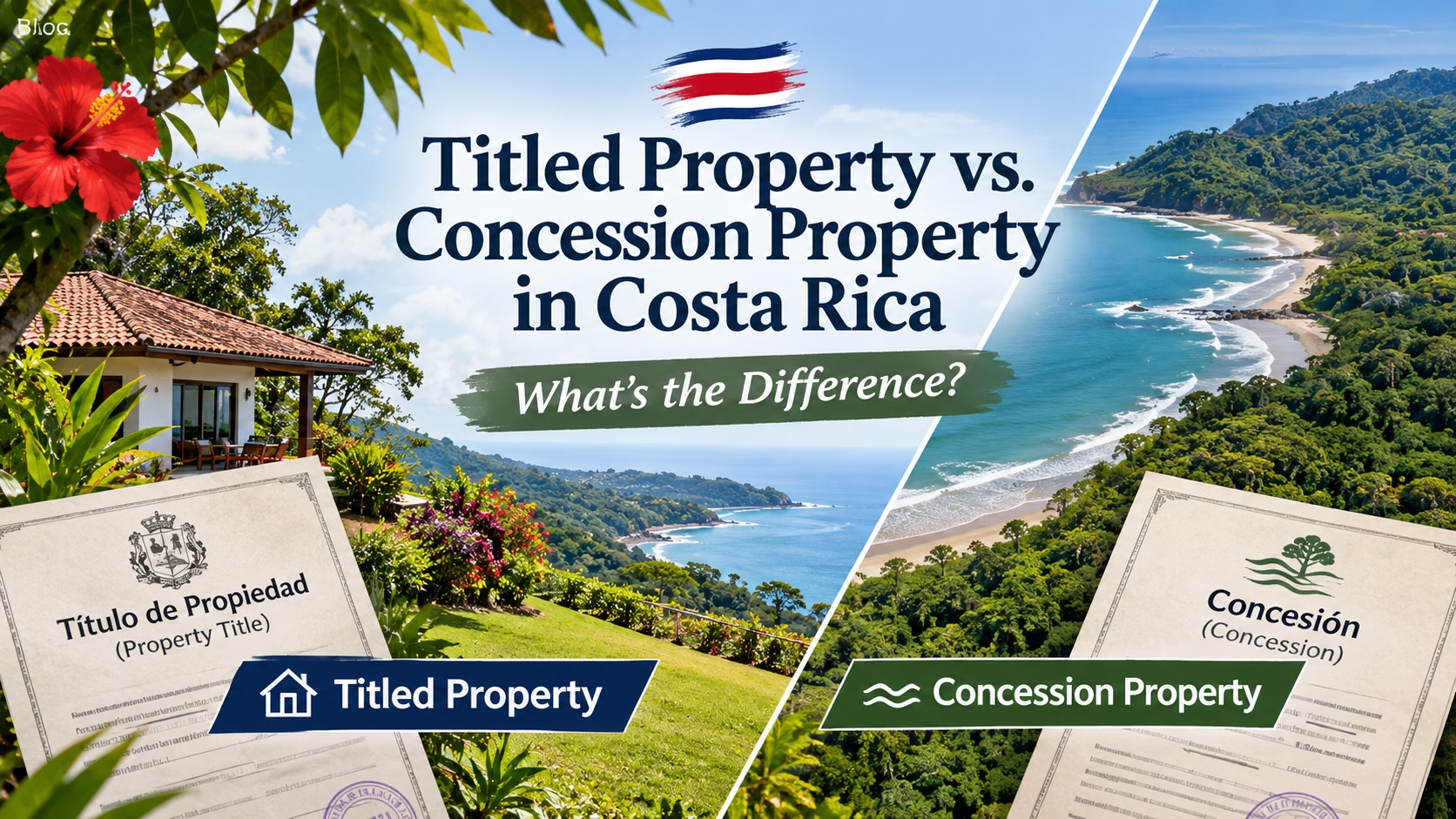
Here’s the short version. Titled property is land you own outright, the way you’d own a house back home. Concession property is land you lease from the government for a set period of time, with real limits on who can hold it and what you can do with it. Let’s break down what that means in practice.
What Is Titled Property in Costa Rica?
Titled property, often called fee simple ownership, means your name (or your company’s name) is registered as the owner at the National Registry (Registro Nacional). You can sell it, rent it, mortgage it, build on it, and leave it to your heirs, with the same rights a Costa Rican citizen has.
The good news for foreign buyers is that Costa Rica is one of the more welcoming countries in the world on this point. As a foreigner, you can buy titled land with just a valid passport. You don’t need residency, a local partner, or a minimum purchase amount. Most of the properties you’ll see for sale across Uvita, Dominical, Ojochal, and Golfito, including hillside lots, ocean-view homes, and jungle properties, are titled.
What Is Concession Property in Costa Rica?
Concession property sits in the Maritime Zone (Zona Marítimo Terrestre, or ZMT), the strip of land along Costa Rica’s coastline governed by the Maritime Zone Law (Law 6043). Here’s how that strip is divided:
- The first 50 meters from the high-tide line is the public zone. Nobody can own it or build on it, and it stays open to everyone.
- The next 150 meters is the restricted zone. The land still belongs to the state, but the local municipality can grant a concession, a long-term right to use and build on the land, typically for terms of 5 to 20 years, with the option to renew.
So when you “buy” a concession, you’re not buying the land. You’re buying the right to use it under the terms of the municipality’s agreement. Instead of regular property tax, concession holders pay an annual fee called the canon to the municipality.
The Big Differences, Side by Side
| Titled Property | Concession Property | |
|---|---|---|
| What you own | The land itself (fee simple) | A right to use state-owned land |
| Duration | Permanent | Fixed term (typically 5–20 years), renewable |
| Foreign buyers | Fully allowed, no residency required | Restricted (see below) |
| Annual cost | Property tax | Canon paid to the municipality |
| Financing | Easier to finance | Harder, with fewer lenders willing |
| Resale | Straightforward | Requires municipal approval of the transfer |
| Risk level | Lower | Higher, with renewal and compliance risks |
The Foreigner Rules (This Is Where People Get Caught)
This is the part that trips up the most buyers. Under Costa Rican law, a foreigner generally needs at least five years of legal residency in the country to hold a concession. Companies are also restricted (our guide Costa Rica Corporation (S.A.) vs. Buying in Your Personal Name: Which Should You Choose? explains how corporate ownership works in general): the law requires that a significant share of a concession-holding company’s capital, commonly cited as at least 50%, be owned by Costa Rican nationals. Municipalities can interpret these rules differently, and some are stricter than others.
You’ll sometimes hear about a workaround where a Costa Rican “partner” holds 51% of the company on paper while you hold the rest. We’d strongly caution against this. These nominee arrangements can leave you with no enforceable rights if the relationship goes sideways, and they’re exactly the kind of “grey area” setup that gets foreign buyers into serious trouble. A company that is perfectly able to hold titled land may still be ineligible to hold a coastal concession.
The takeaway: if you’re a newer arrival without five years of residency, concession property is usually not a straightforward option for you, no matter how attractive the listing looks.
Is Concession Property Ever a Good Idea?
It can be, for the right buyer. Concession lots are often priced lower than comparable titled land, and for someone who qualifies, such as a long-term resident or Costa Rican citizen, and who understands the terms, they can be a good way to get close to the beach.
But go in with eyes open. Before considering a concession, you’d want to confirm the following (our Due Diligence Checklist Before Buying Land in Costa Rica covers the full process):
- The concession is active and in good standing, with no unpaid canon fees or violations. An expired or non-compliant concession can be revoked.
- How many years remain on the term, and what the renewal process looks like with that specific municipality.
- Whether the municipality has an approved regulatory plan (plan regulador) for that stretch of coast. Without one, concession rights can be uncertain.
- Whether any structures sit inside the 50-meter public zone, because those have no legal standing, regardless of what a seller tells you.
- How a transfer works. Selling a concession typically requires municipal approval, which adds time and uncertainty to an exit.
What About the “Beachfront” Lots I See Listed?
This is where it pays to read listings carefully. In the Costa Ballena area, true “beachfront” often means concession land, because anything within 200 meters of the high-tide line falls in the ZMT. The titled properties you’ll find near the coast tend to sit just outside that 200-meter line, on a bluff, ridge, or set-back lot with ocean views, which is why ocean-view titled land is such a popular option for buyers who want security of ownership without giving up the scenery.
Whenever you see a coastal listing, ask a simple question first: “Is this titled, or is it a concession?” A good agent will answer clearly and put it in writing. For a deeper look at coastal ownership, read Can Foreigners Own Beachfront Property in Costa Rica?
Why Working With a Professional Real Estate Office Matters
Here’s the honest truth: nothing in this article replaces a conversation with a qualified Costa Rican real estate attorney. Concession law has moving parts, municipalities interpret it differently, and rules around residency and corporate ownership change over time. That’s exactly why who you work with matters.
Century 21 Ballena Properties is a professional real estate office built specifically for the Southern Zone. We work every day in the markets where this distinction matters most, in Uvita, Dominical, Ojochal, and Golfito, and we know which listings are titled, which are concessions, and which need a closer look before anyone gets emotionally (or financially) invested. Here’s what that looks like for our clients:
- Clear answers up front. We tell you whether a property is titled or concession land before you fall in love with it, not after.
- Local, on-the-ground knowledge. We know the municipalities, the common pitfalls, and the properties that look better on paper than they are in person.
- Bilingual service. Our team works comfortably in both English and Spanish, so nothing gets lost in translation, especially in legal paperwork.
- A network of trusted professionals. We connect you with independent attorneys, surveyors, and other specialists who can complete proper due diligence on your behalf.
- The backing of a global brand. As part of the Century 21 network, we bring international standards of professionalism to the Costa Rican market.
Whether you’re looking for a first vacation home or a long-term investment (and if you’re still deciding between the two, see Is It Better to Buy Land or a Home in Costa Rica?), our goal is the same: help you buy the right property, with eyes wide open.
Related Reading
- Can Foreigners Own Beachfront Property in Costa Rica? | Read article →
- Due Diligence Checklist Before Buying Land in Costa Rica | Read blog →
- Costa Rica Corporation (S.A.) vs. Buying in Your Personal Name: Which Should You Choose? | Read article →
- Is It Better to Buy Land or a Home in Costa Rica? | Read the guide →
- Pitfalls of Buying Property in Costa Rica for Foreigners | Read blog →
- 5 Mistakes Foreign Buyers Make When Buying Costa Rica Real Estate | Read article →
- Best Areas for Rental Income Near Costa Ballena, Costa Rica | Read the guide →
At Century 21 Ballena Properties, we specialize exclusively in Costa Rica real estate in the Southern Zone. Browse current listings for Dominical real estate, Uvita real estate, Ojochal real estate, and Golfito real estate, or contact our bilingual team to find out whether a property you’re considering is titled or concession land.
Frequently Asked Questions
What is the difference between titled property and concession property in Costa Rica? Titled property is land you own outright (fee simple), with full rights to sell, rent, mortgage, and inherit it. Concession property is state-owned land in the maritime zone that you hold a long-term right to use, typically for 5 to 20 years with renewal, in exchange for an annual fee (canon) to the municipality.
Can foreigners own titled property in Costa Rica? Yes. Foreigners can buy and own titled property with the same rights as Costa Rican citizens, with no residency requirement.
Can foreigners own concession property in Costa Rica? Only under restrictions. Foreigners generally need at least five years of legal residency to hold a concession, and companies face ownership requirements that limit foreign control. Always confirm the specifics with an attorney, since municipalities can interpret the rules differently.
What is the maritime zone (ZMT) in Costa Rica? It’s the 200-meter strip along the coastline governed by the Maritime Zone Law. The first 50 meters is public and cannot be owned or built on. The remaining 150 meters is the restricted zone, available only through municipal concessions.
Is titled property better than concession property? For most buyers, yes. Titled property offers permanent ownership, easier financing, and a simpler resale process. Concession property can work for qualified buyers who understand the terms, but it carries more legal and renewal risk.
How do I know if a property is titled or concession? Ask your agent directly, and have your attorney verify it through the National Registry and the municipality. A reputable agent will confirm the status in writing before you make an offer.