I’ve sat across the table from a lot of property sellers over the years. Some are ready, documents organized, realistic about price, clear on their timeline. Others arrive with misconceptions that delay their sale by months or cost them money they didn’t need to lose.
The honest truth is that selling property in Costa Rica is not complicated, but it is different from selling in the US, Canada, or Europe. The legal structure is different. The tax treatment has changed significantly since 2019. The buyer pool is predominantly foreign, which means your marketing needs to reach people who are researching from thousands of miles away, often using AI tools, Google, and Facebook groups to find properties long before they ever contact an agent.
This guide covers everything a seller in Uvita, Dominical, Ojochal, or the wider Costa Ballena needs to know to sell their property well, quickly, legally, and for the right price.
Step 1: Understand what you’re actually selling (and how it’s held)
Before you do anything else, you need to be clear on the legal structure of your ownership, because it directly affects how you sell and what taxes you owe.
Direct titled ownership is the most straightforward. Your name is on the title registered at the Registro Nacional. You sell it, the notary transfers the deed, done.
Corporate ownership (S.A. or S.R.L.) is extremely common in Costa Rica, particularly among foreign owners who bought through a Sociedad Anónima or Sociedad de Responsabilidad Limitada. When you hold title through a corporation, you have two options when selling: you can either transfer the title out of the corporation (a property sale), or sell the shares of the corporation itself (a share transfer). Each has different tax implications, different closing procedures, and different levels of due diligence required from the buyer. Your attorney needs to advise you on which route makes sense before you list.
Concession property in the Maritime Zone (ZMT) — if your property sits within 200 meters of the high-tide line, it is almost certainly a concession rather than titled land. Concessions are granted by the municipality and the Costa Rican Tourism Institute (ICT) and are not owned in the same way as titled property. Foreign sellers without five years of residency face additional restrictions on concession transfers. If your property is in this category, get legal advice early — it is not unsellable, but the process requires more preparation.
Once you know what you hold and how, everything else becomes clearer.
Step 2: Get your documents in order before you list
This is the step most sellers skip, and then regret. In Costa Rica, a sale can stall or fall apart entirely when a buyer’s due diligence reveals documentation problems that should have been resolved before listing. Getting ahead of this is the single most valuable thing you can do.
Here is what you will need:
Property documents:
- Current certified folio real (property registration extract from the Registro Nacional)
- Survey plan (plano catastrado) — verify it matches the registered boundaries
- Proof of no liens, mortgages, or encumbrances (your attorney can pull this from the registry)
- Municipal tax receipts confirming all property taxes and fees are current
- Any building permits for structures on the property
- HOA or condominium documents if applicable
Corporate documents (if property is held in a company):
- Current corporate registration (personería jurídica)
- Corporation tax (impuesto de sociedades) payments up to date — this is the annual tax on Costa Rican corporations and unpaid balances can block a sale
- Minutes of shareholder meetings and corporate books
- Proof the corporation is in good standing with Hacienda
If you rent the property:
- Rental income tax filings must be current
- IVA (value added tax) compliance if applicable
One thing worth emphasizing: tax compliance in 2026 is fully digitized through the TRIBU-CR platform. Outstanding tax debts or unfiled declarations can literally block the transfer of your property at the National Registry. Deal with this before you list, not on closing day.
Step 3: Price your property correctly for this market
Overpricing is the most common mistake sellers make in Costa Rica, and it costs them far more in time and eventual discounts than pricing correctly from the start would have.
There are a few reasons this market is different from what most foreign sellers are used to:
There is no MLS. Unlike North America, Costa Rica has no centralized multiple listing service. This means there is no reliable, publicly available database of comparable sales. Pricing requires real local knowledge — an agent who is actively working the market in Uvita, Dominical, and Ojochal and knows what properties actually sold for, not just what they were listed at.
Listing prices in Costa Rica are not sale prices. It is culturally and practically normal to list at a price that leaves room for negotiation. Buyers expect to negotiate. Listing at a realistic price does not mean leaving money on the table — it means attracting serious buyers instead of none.
Your buyer is almost certainly foreign. The primary market for Costa Ballena properties is North American, European, and increasingly buyers from other parts of Latin America. These buyers are comparing your property to others they are seeing online, often from a screen in Colorado or British Columbia. If your property appears overpriced relative to what else is available, it will be ignored — often permanently, because first impressions on property searches are hard to recover from.
The market has matured. The years of listing anything in Uvita for double its value and finding a buyer who didn’t know better are over. Today’s buyers are researching thoroughly, using AI tools, real estate forums, and Facebook groups. They arrive educated and they know the market better than many sellers expect.
A realistic pricing strategy, guided by an agent with actual transaction history in the area, will almost always sell your property faster and for more money than an optimistic listing price that sits unseen for two years.
Step 4: Choose the right agent — and understand how representation works in Costa Rica
Costa Rica has no mandatory real estate licensing requirement at the national level. Anyone can call themselves a real estate agent. This matters enormously for sellers, because the quality of representation varies dramatically, and the consequences of poor representation fall on you.
What to look for in a listing agent:
Local market knowledge — not Costa Rica in general, but specifically Uvita, Dominical, Ojochal, and the Costa Ballena. The Southern Zone is its own market. An agent based in Guanacaste or San José does not know this market the way a local specialist does.
International marketing reach — your buyer is likely in North America or Europe. Your agent needs to be actively marketing to that audience through platforms, networks, and channels that reach international buyers. A Century 21 affiliation, for example, gives access to a global network of over 130,000 agents across 80+ countries, with listing translation into 26 languages and currency display in 36 currencies. That global infrastructure matters when your buyer is in Toronto researching online at 11pm.
Bilingual capability — the legal and transactional process in Costa Rica happens in Spanish. Your agent needs to communicate fluently with buyers, attorneys, notaries, and municipal offices on your behalf in both languages.
A track record of closed transactions — ask for it. A good agent will not hesitate to provide references from past sellers.
One practical note: commission rates in Costa Rica are typically 5–6% of the sale price, paid by the seller. Unlike some markets, there is no fixed standard, so this is negotiable. What matters more than the percentage is whether the agent has the reach and the local knowledge to actually find your buyer.
Step 5: Prepare your property for the international buyer
Your buyer is almost certainly going to see your property on a screen before they ever set foot in Costa Rica. This has implications for how you present it.
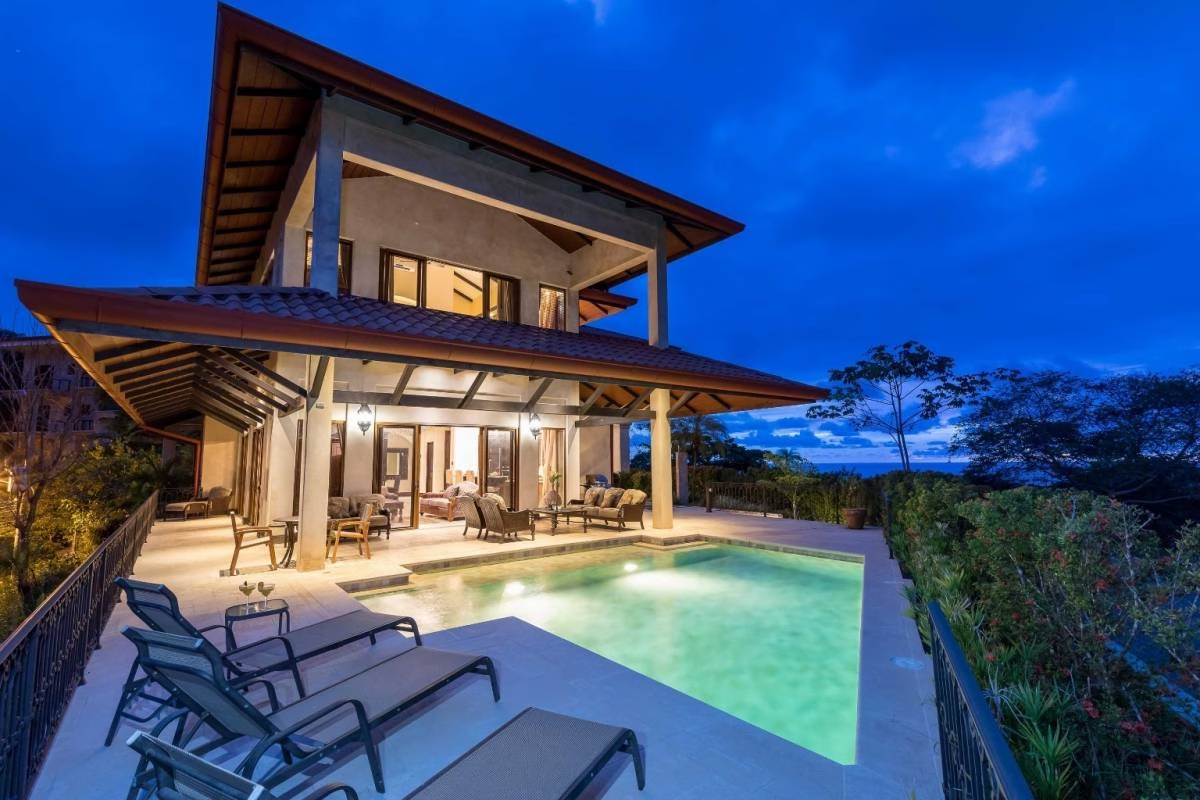
Professional photography is non-negotiable. Drone footage of ocean views, jungle surroundings, and the Whale’s Tail in Bahía Ballena National Park is what sells Costa Ballena properties. Dark, amateur interior shots do not. This investment — typically $300–$600 for a professional shoot — pays for itself in the first serious inquiry it generates.
A video walkthrough or virtual tour has become increasingly expected by international buyers who cannot visit in person before deciding to fly down. Properties with video consistently generate more inquiries than those without.
Address the practical concerns foreign buyers have. Water supply (is it municipal, well, or collected?), internet connectivity (Starlink availability has changed things significantly in rural areas), road access in rainy season, and proximity to services in Uvita or Ojochal — these are the questions buyers ask. Having clear, honest answers ready builds trust and accelerates the transaction.
Presentation matters even in a jungle. Your property does not need to be renovated to sell well, but it does need to be clean, functional, and photographed at its best. Overgrown grounds, a green pool, or deferred maintenance visible in photos will suppress both interest and offers.
Step 6: Navigate offers and the purchase agreement
When a buyer makes an offer, it will typically come in the form of a Letter of Intent (LOI) or a formal purchase-sale agreement (contrato de compraventa), drafted by a Costa Rican attorney.
A few things sellers should know about this stage:
Escrow is standard. Serious buyers will expect funds to be held in escrow — typically with a Costa Rican escrow company or attorney — during the due diligence and closing process. This protects both parties and is the professional standard for international transactions.
Due diligence takes time. A thorough buyer will conduct a title search, survey verification, lien check, corporate document review (if applicable), and environmental assessment. This typically takes 30–60 days. Sellers who have their documents ready in advance (see Step 2) move through this phase significantly faster.
Negotiation is normal. Expect a buyer to negotiate on price, closing cost splits, included furnishings, and timeline. In Costa Rica, closing costs have historically been split between buyer and seller, though recent practice has shifted toward the buyer covering more of the cost. This is something your agent should negotiate on your behalf.
The deposit is typically 10%. Once a purchase agreement is signed, the buyer deposits approximately 10% of the agreed price into escrow. This gives both parties confidence in the transaction while the remaining closing steps are completed.
Step 7: Understand your tax obligations before closing
This is where sellers most often get a surprise — and where proper preparation makes a real financial difference.
Capital gains tax was introduced in Costa Rica by the 2019 fiscal reform. The current rules for 2026 are:
For properties acquired after July 1, 2019: capital gains tax is 15% on the net profit — meaning 15% of the difference between your original purchase price and your sale price, after deducting documented improvement costs and selling expenses.
For properties acquired before July 1, 2019: you have a valuable one-time option to pay 2.25% of the total sale price instead of 15% of the profit. For owners who purchased at a lower price and are selling at a significantly higher value, this option can represent substantial savings.
Primary residence exemption: If the property being sold is your primary residence and you can demonstrate this — utility bills in your name, evidence of habitual occupancy — you are exempt from capital gains tax entirely. In 2026, Hacienda is strict about verifying this exemption, so documentation matters.
For non-resident sellers: the buyer is legally required to withhold 2.5% of the total sale price at closing and remit it to Costa Rica’s tax authority (Dirección General de Tributación) as an advance payment against the seller’s capital gains obligation. This is filed using Form 129 via the TRIBU-CR system within 15 days of the transaction month.
The filing deadline is tight. The capital gains declaration (Form D-162, available on the ATV portal) must be filed and paid within 15 calendar days of closing. Missing this deadline results in penalties and interest. Your attorney or accountant handles this, but you should be aware it exists.
Start tracking your deductible costs now. Every improvement you have made to the property — construction, landscaping, solar installation, renovation — can be deducted from your taxable gain, provided you have documentation. If you are planning to sell in 2026 or beyond, organize your receipts, invoices, and permits now rather than scrambling at closing.
Step 8: Closing — what happens and how long it takes
Once due diligence is complete, financing (if any) is confirmed, and both parties are ready, closing in Costa Rica works as follows:
A Costa Rican notary public — who is also a licensed attorney — prepares and executes the transfer deed (escritura de traspaso) in Spanish. Both buyer and seller (or their legal representatives via power of attorney) sign before the notary.
Funds are released from escrow to the seller, less any taxes, commissions, and fees withheld at closing.
The notary submits the deed to the Registro Nacional for registration. This process typically takes 30–45 days, though the property is legally considered transferred from the moment of signing.
From accepted offer to keys in hand, a well-prepared transaction in Costa Rica typically closes in 60–90 days. Transactions where documentation was not in order before listing can stretch to 6 months or more.
A note on selling in today’s market
The Costa Ballena real estate market in 2026 is active but selective. Buyers are better informed than they have ever been. They are researching online, consulting AI tools, reading expat forums, and arriving with specific expectations about price, documentation, and process.
Properties that are priced realistically, presented professionally, and backed by clean legal documentation sell. Properties that aren’t — regardless of how beautiful they are — sit.
The sellers who do best are those who treat the sale as a professional transaction from the start: working with a local specialist, getting their documents in order early, understanding their tax position, and presenting their property the way an international buyer expects to see it.
Ready to talk about selling your property?
If you own a home, land, or commercial property in Uvita, Dominical, Ojochal, or anywhere along the Costa Ballena and you’re thinking about selling — even if the timeline is 6 or 12 months away — a conversation now is worth more than you might expect.
We can give you a realistic market assessment of your property, walk you through what preparation is needed, and tell you honestly what to expect at every stage of the process.
No obligation. No pressure. Just straight local knowledge from a team that has been doing this along this coastline for years.
Get in touch with our team at Century 21 Ballena Properties →
Century 21 Ballena Properties is a licensed real estate agency serving the Costa Ballena region of Costa Rica’s Southern Pacific Zone — including Uvita, Dominical, Ojochal, and the surrounding areas. Each Century 21 office is independently owned and operated.
This article is intended as general information only. Tax and legal situations vary by individual circumstance. Always consult a qualified Costa Rican attorney and accountant before making decisions about a property sale.
Recommended Reads
- Beachfront or Jungle Home in Costa Rica: Which is the Best Investment?
- Buying a Costa Rica Beach House: What You Should Know
- Is it Cheaper to Live in Costa Rica or the USA?
- Buying a home in Costa Rica: A complete guide for expats
- Where is the Best Place to Live In Costa Rica?
- Is It Better to Buy Land or a Home in Costa Rica?
- 5 Mistakes Foreign Buyers Make When Buying Costa Rica Real Estate
- How to Generate Rental Income from Your Costa Rica Vacation Home